
Sponsor Licence Suspension & Revocation
Sponsor Licence & Employer Compliance
Urgent help when the Home Office suspends, downgrades or revokes a sponsor licence, including representations and action plans.
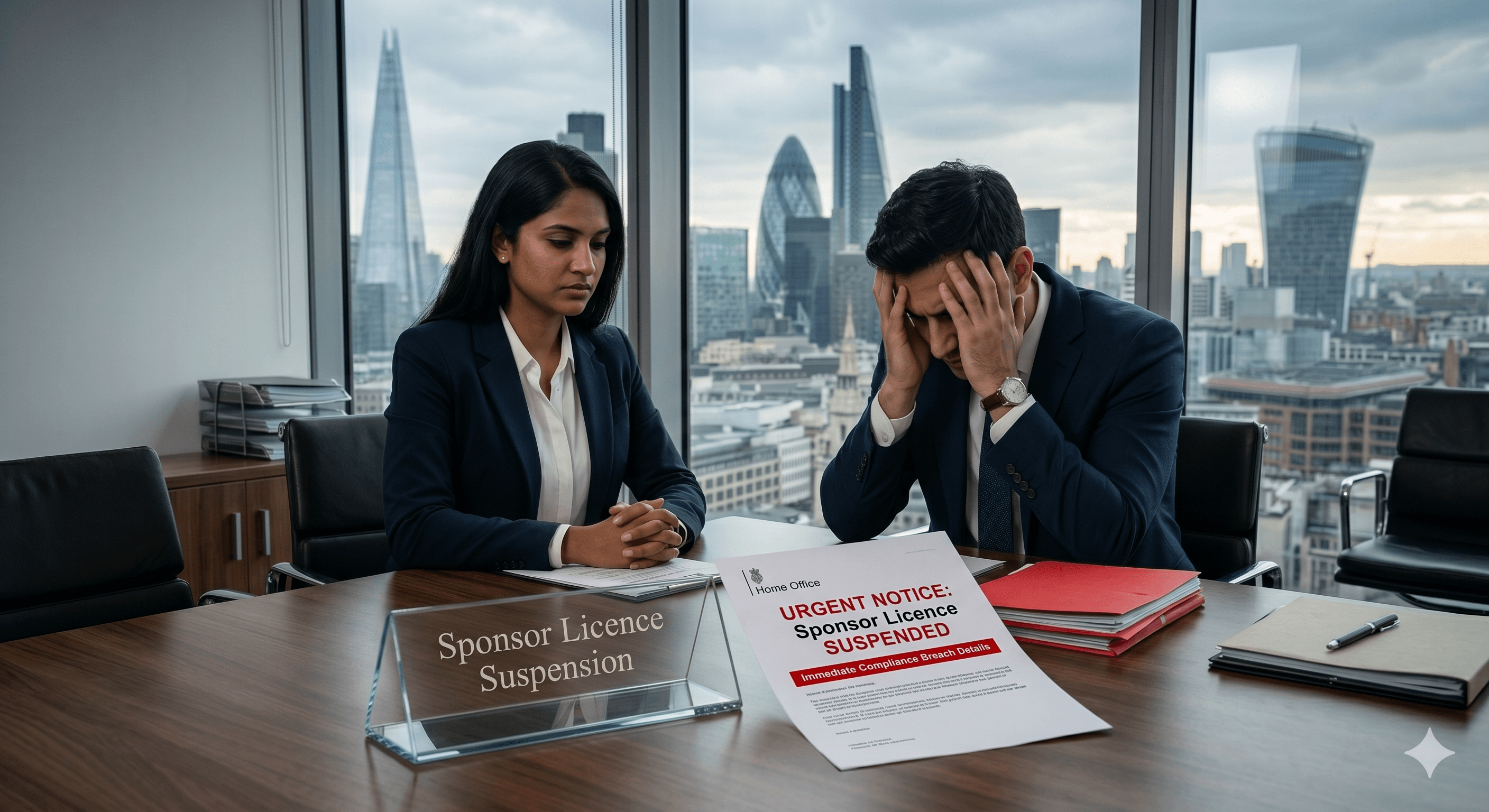
When the Home Office has concerns about how a sponsor is meeting its duties, it can take action ranging from a downgrade to suspension and, ultimately, revocation of the licence. These steps can have serious consequences for the business and for every worker it sponsors, and the timescales for responding are short.
The earlier we are involved, the more options there usually are. A clear, evidence-based response that deals with each concern can make a real difference to the outcome, although no outcome can be guaranteed.
Why action is taken
The Home Office's grounds for action are set out in Annex C of the sponsor guidance, divided into grounds where it must, will normally, or may revoke a licence. Common triggers include:
- Missing or incomplete records for sponsored workers, including right to work checks.
- Failing to report changes on the Sponsor Management System on time.
- Roles that do not match the Certificate of Sponsorship, or that do not appear to be genuine.
- Pay below the level stated on the certificate.
- Recovering sponsorship costs from workers.
- A civil penalty for illegal working.
- Problems found during a compliance visit.
Downgrading and action plans
For relatively minor breaches, the Home Office may propose downgrading the licence from an A-rating to a B-rating. The sponsor has 20 working days to respond to the proposal. A B-rated sponsor must pay the action plan fee, currently £1,579, within 10 working days, or the licence will be revoked. Action plans last a fixed 3 months, and no new workers can be sponsored while the licence is B-rated.
A sponsor can only be downgraded twice in any rolling 4-year period. A further qualifying breach leads to revocation.
Suspension
If the Home Office suspends a licence, the sponsor cannot assign any Certificates of Sponsorship and is removed from the public register of sponsors while the suspension lasts. The position of existing sponsored workers depends on the outcome.
The sponsor has 20 working days from the date of the written notice to respond. If new grounds are raised during the process, a further 20 working days are given. The Home Office aims to decide within 20 working days of receiving the response.
Responding effectively
- Analyse each ground in the letter carefully.
- Carry out an urgent internal review of sponsored worker files and processes.
- Gather documents that answer each concern directly.
- Put corrective measures in place and evidence them.
- Submit clear written representations within the deadline.
Representations are most persuasive when they admit genuine mistakes, explain how they happened and show, with evidence, that effective changes have already been made. Simply denying the concerns, or missing the deadline, rarely helps.
Revocation
If the Home Office revokes a licence, there is no right of appeal. Revocation applies to all the routes on the licence. In some cases a legal challenge by way of judicial review may be possible, and we can advise on whether that may be appropriate, but it is not an appeal on the merits and time limits are strict.
The effect on sponsored workers
When a licence is revoked, sponsored workers' permission is normally cancelled or shortened. Affected workers then need to consider their options, such as finding a new licensed sponsor or switching to another route, within the time they are given. We also advise workers affected by a sponsor's revocation.
Cooling-off periods
After revocation, a sponsor generally cannot reapply for a period. Under the current guidance:
- 12 months after a first revocation, or after surrendering a licence during compliance action.
- 24 months after more than one revocation.
- 12 months after full payment of an illegal working civil penalty, and up to 5 years after two or more penalties.
- Indefinitely while a civil penalty remains unpaid.
No cooling-off period applies where the only reason for revocation was the removal of inactive SMS user accounts.
How Stonebridge can help
- Urgent review of suspension, downgrade or revocation letters.
- Internal audits to identify and correct the issues raised.
- Drafting detailed representations with supporting evidence.
- Advising on and managing action plans.
- Advising on the options after revocation, including whether judicial review may be available.
- Advice for affected workers on their immigration options.
Deadlines in these cases are short. If you have received a letter from the Home Office, book an urgent consultation or contact us straight away.
Speak to an Adviser
Ready to Discuss Your Case?
Book a confidential 30-minute consultation with an IAA-regulated adviser, in London, Birmingham, or by phone and video.